
Anna Membrino “Dew”

by John Zotos
Erin Cluley Gallery, Dallas, Texas
Continuing through May 9, 2026

In Anna Membrino’s approach, landscape painting starts with photographs of the natural world. Then, with a technique involving collage and digital alterations on a computer screen, she arrives at an image worthy of the intense shifts in scale, color, and surreal mystery that has defined her output over the last ten years.
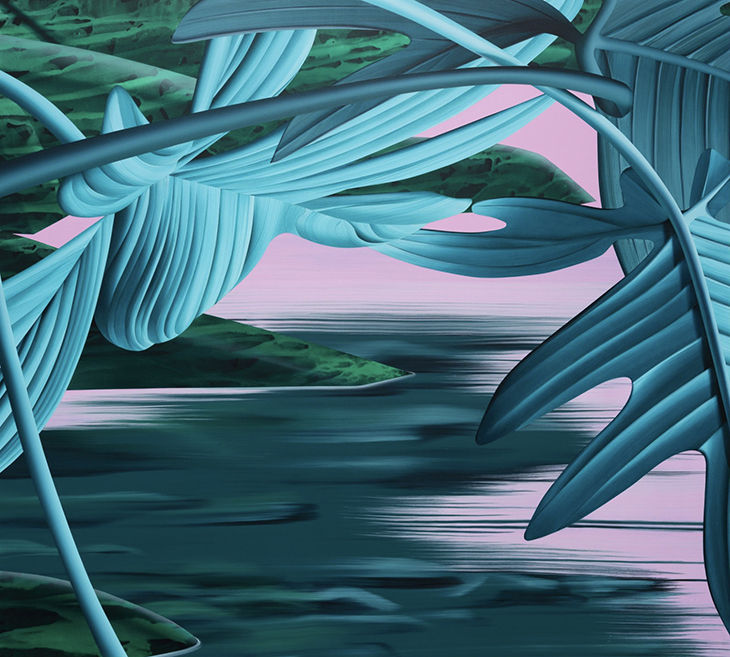
The images are surreal to the degree that they depict a reality with a color scheme all their own. It’s a presence replete with memories, anxiety, bliss, and/or dreams. Her major works always require a large-scale format, which in a work like “Dew” averages around 65 by 65 inches.

For these new paintings, Membrino has inverted her point of view. Previously we beheld a scene as if walking onto a theatrical stage, where the vegetation and other elements form a perimeter around a clearing. Now Membrino places us among, or behind, the elements that form that visual border, obstructing the view onto a vast space beyond. By doing so, the scale of the elements closer to the surface are perceived as larger than in reality. This resembles the cinematic use of such a conceit by Raul Ruiz in his neo-surrealist film melodramas, where flowers and vegetation move around the actors, engulfing the frame and disorienting the viewer.
In “Steep” (2026), a vertical stalk with leaves sprouting in all directions firmly occupies the foreground in a deep, detailed, pulsating blue. It resembles a bamboo tree that has taken up most of the center left area of the canvas. After trying to peer beyond the tree, we see farther into the background. There are a series of rolling hills in a lilac-purple hue that bathes them in sunlight, surrounding a watery lagoon in blue that also reflects the rays of light. In the deep background there is a hint of light red, a sign that dawn approaches. We either delve into memories of consciousness on the shore of oblivion, like the instant we wake from a dream, or suddenly lapse into sleep.

In the largest work, “Drift” (2026), we peer through a vantage point in the center of the composition defined by long vegetative stalks capped by leaves rendered in a light turquoise. Bathed in light, the flora navigate the canvas from the left, around the top, and to the right, circumscribing the visual field and obstructing a clear view of the sky in the background. Visible below is a water feature surrounding a span of land in green. The hint of a horizon line intentionally gives “Drift” a measure of depth missing in other paintings like “Steep” and “Dew,” where obstruction and confinement complicate Membrino’s ever-changing relationship with nature.
What never varies is the idea that the viewer stands in for the general human presence. There remains no evidence of the human figure in these paintings, or any suggestion of how the landscapes may have fallen prey to human agency. Unlike in the physical world, where we’re hard-pressed to find untouched nature — primarily because it only exists as something culturally identified — Membrino’s hyper-realities may offer a temporary escape from the actuality of our painful present.

John Zotos is an art critic and essayist based in Dallas.


Comments