
Jack Snell-Ryan, “Ohm Loop”

by Matthew Kangas
Continuing through August 15, 2026

Conceptual sculpture is the musty afterbirth of Conceptual Art. Jack Snell-Ryan’s “Ohm Loop” moves beyond the meager austerities of a form that first emerged during the 1970s — no color, no object, ideas-only allowed — into an area that blends available materials like cast concrete and pencils with a range of brainy intentions the artist has stated explicitly elsewhere. It’s all reinforced by curator Ido Radon’s lengthy explication: sound theory; vernacular objects such as transistor radios and tape cassettes; the possibility of writing; and how egg cartons can symbolize architecture. These thoughts are the form’s inextricable legacy. One cannot fully appreciate his sculpture without the interpolation of the textual accompaniment of the artist’s and curator’s intentions. The question is, do they add up to a satisfying aesthetic experience or remain ambiguous and hermetic?

By the time Conceptual Art reached its apex in the late 1970s, words alone were left to create aesthetic meaning, as in the work of Jenny Holzer, Lawrence Wiener and Barbara Kruger. The problem was that Holzer’s slogans and “truisms” or Wiener’s phrasemaking plastered on museum walls were clichés and often simply examples of bad writing, trite and obvious. Younger artists such as Snell-Ryan relegate the conceptual baggage to intentional statements and leave the heavy lifting of interpretation to curators like Radon. Viewers are left out in the cold, subject to spelled out lecturing on obtuse topics such as sound theory and the inherent inescapability of repetitive audio environments in popular culture. Better yet, they were left on their own to decipher the artist’s unusual conglomerations of egg cartons, shelf speakers and metal grids.
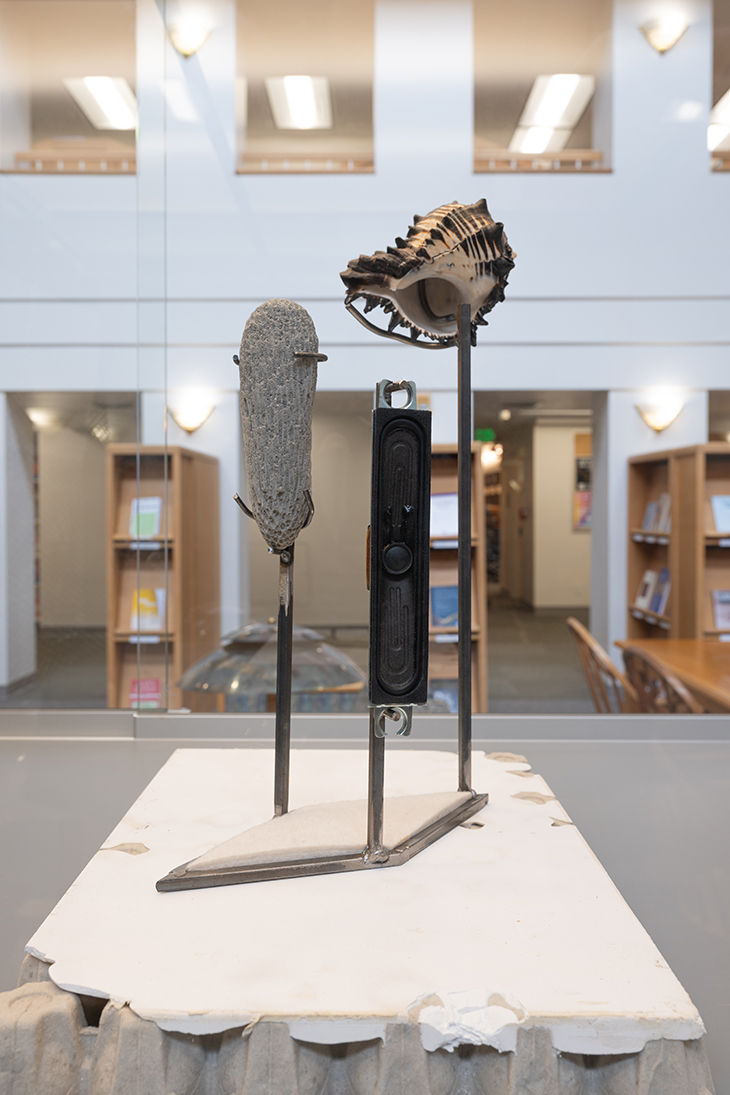
For those who might be unable to see the exhibit, displayed in two narrow glass cases in the reading room adjacent to the gallery, or who do not have access to the garbled explanatory verbiage (nowhere in sight), scrutiny of the encased objects might help unravel what meaning, let alone visual pleasure, they emit. This will rescue the viewer from Radon’s invoking Bertolt Brecht’s weighty term verfremdungseffekt (alienated distancing), which leaves us nowhere. Looking closely is always the best approach.
Contemplate “Embassy Tower” (2023-2026), stacked egg cartons over felt and covered in plastic. Minimally like Minimal Art, its modest scale of 28 by 36 inches spoofs modernist architecture and its deadening appearance in official buildings. (It might be about the American embassy in Havana, Cuba that was bombarded with high-pitched sounds.) It’s hard to imagine the piece required three years of construction but maybe that involved 35 months of thinking and one month of stacking and gluing. A bit bigger at 29 by 50 inches, “Framed Void (with Flagpoles)” (2026) again mimics the internal structures of architecture instead of outer covering, sort of like the inside-out look of the Pompidou Center in Paris, but without the visible plumbing and electrical pipes. The flagpoles of the title are nowhere to be seen either.

“Shelf Speaker Tower” (2025) dredges up the dated look of an old music system, casting the speaker (about 20 inches high) in “Roman” concrete as if it were an excavated archaeological object. We recognize the shelf speaker’s origin and note that, enshrouded in concrete, it has become a fossilized forerunner of digital sound and its projection of music through ear buds.
Above these on a clear glass shelf is “Transistor Void” (2024), a relic of the earliest personal sound systems. It’s the only thing here with any kind of surface decoration at all: an oval rock with striations all over resembling a fish. Beneath it is a stacked wood block with visible graining perched atop narrow rectangles of concrete and corrugated cardboard. So stark is the sculpture’s presence in relation to the austerity of the adjacent artworks that “Doorstop” takes on the character of a Brâncuşi masterpiece: off-center, artisanally carved, and ambiguously beautiful. Its title typifies the deadpan modesty of Snell-Ryan’s entire undertaking.

By this time we are so hungry for visual texture or hands-on intervention that three final works take on comparable stature. “Conch Loop” (2021-2026) (five years in the making!), with two seashells held up by a steel armature, uses the beach detritus as mock speakers (as when put to one’s ear to “hear the ocean”). “Shelf Speaker/Pencils” (2023) freezes an old speaker in concrete and adds another rock and pencils, all in a plywood box to compress listening, writing and making. Finally, in the back office, “X Double Aught” (2026) is a screen-printed monotype with scrawled green oil stick. Patterned and scribbled on, its materiality and human touch undercut the hands-off approach of the other objects. They are all conceptual sculptures that project rueful nostalgia on the embodiments of historically distant auditory experiences.
Matthew Kangas writes regularly for Visual Art Source eNewsletter; Ceramics: Art & Perception (Australia); and Preview (Canada). Besides reviewing for many years at Art in America, American Craft, Art Ltd., Vanguard and Seattle Times, he is the author of numerous catalogs and monographs, the latest being the award-winning Italo Scanga 1932-2001. Four anthologies of his critical essays, reviews and interviews were issued by Midmarch Arts Press (New York) and available on Amazon at Books by Matthew Kangas


Comments