
Ken Gonzales-Day, History’s ”Nevermade” (USC) and “Afterlife” (Luis De Jesus)

by Jody Zellen
USC Fisher Museum, Los Angeles
Continuing through March 14, 2026
Luis De Jesus, Los Angeles California
Continuing through December 20, 2025

Ken Gonzales-Day's mid-career survey “History’s “Nevermade"” moves us through three decades of work. While the investigation of race and queer identity is core to Gonzales-Day's pursuits, he also looks deeply into history and politics from a theoretical perspective, which is not surprising given his role as an educator and writer. Seen together, the works speak to cultural memory and how we see the present in relation to the past.

While still in high school and later as an undergraduate, Gonzales-Day made representational figurative paintings and drawings. Many of these pieces are installed salon style to the left of the entry room. These early works illustrate both a trajectory and a continuum of his interests in the male figure and his skills in eliciting trust and compassion between artist and model.
Continuing chronologically through the exhibition, the installation includes a significant early series, “The Bone Grass Boy” (1993-1996) This work consists of both a suite of photographs and a historical fiction written by Gonzales-Day set in the 1800s illustrating and describing the life of Ramoncita, a transgendered, two-spirited figure who is purported to be an ancestor of the artist. In the photographs created between 1994 and 1997, Gonzales-Day dresses up to play the various characters in the fictitious narrative, clearly delighting in rewriting and reinterpreting history.
In his haunting “Erased Lynching” series begun in 2006, Gonzales-Day researched the history of lynching in the America West, specifically focusing on vigilante violence against Latinos, Chinese, and Native Americans in California. Printing on both a small and mural scale, Gonzales-Day digitally removed the victims and seamlessly filled in the background trees to highlight the white spectators while creating an eerie absence. An abiding interest in landscape and memory led to another series, “California Hang Trees.” Gonzales-Day traveled around California documenting the trees used for hangings and their locations. The black and white photographic mural “The Wonder Gaze, St. James Park (Lynching of Thomas Thurmond and John Holmes, Santa Rosa, 1933)” (2006), here spans nearly 20 feet. A crowd lingers, illuminated in front of a deep black background. A single barren tree extends from the ground toward the sky, the two hanged men erased from the image but left to our imagination. Twenty-one postcard size images from the “Erased Lynching” series are presented in a grid emphasizing the enormity of these injustices against men of color.

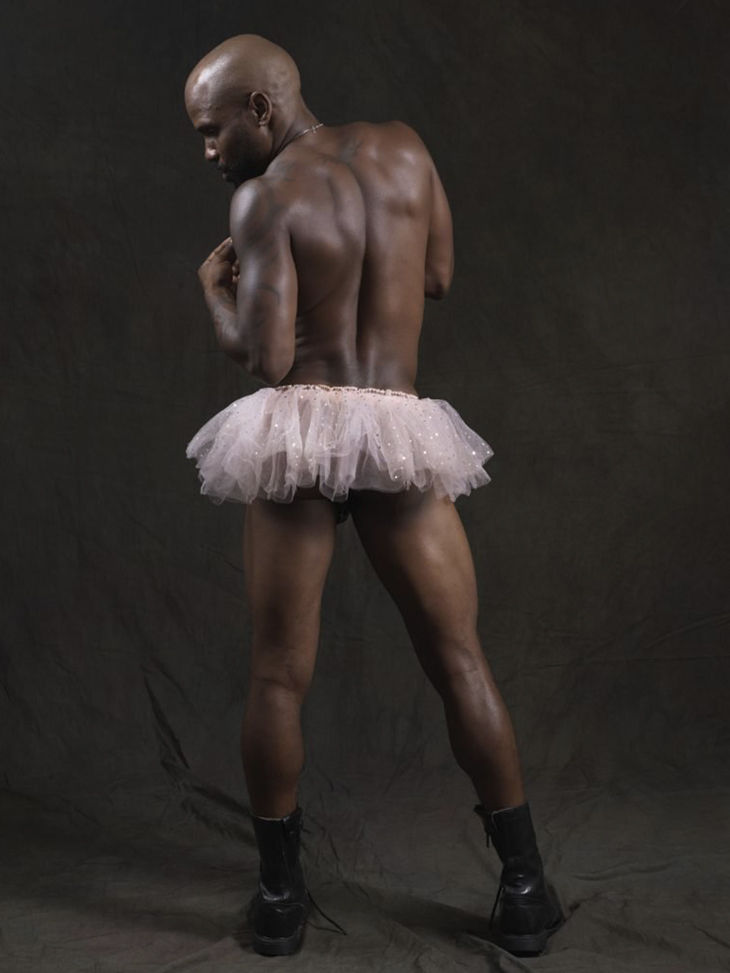
In addition to using found imagery as a point of departure, Gonzales-Day also makes photographs of friends and acquaintances. These are often shot in a studio against neutral backgrounds. In “Anthony” (2007), from the “Memento Mori” series, and “Tadareius Johnson” (2020), from the “Pandemic Portrait” series, he celebrates queer bodies. Among the most interesting images are examples from the “Dysmorphologies” and “Profiled” series. In “Dysmorphologies #94” (1999), Gonzales-Day compares and contrasts different skin types by digitally assembling grids of fragmented body parts evocatively arranged by tones and shapes. For the images in his “Profiled” series, he photographs antique statues from museum collections and represents them en masse against black backgrounds. This series examines race and racial profiling within museum collections. “41 Objects Arranged by Color” (2016), is an impressive mural covering an entire wall in which Gonzales-Day digitally juxtaposes statues that vary in tone from back to white. He removes their settings, isolating the individual shapes against a black background. He standardizes the size of the statues to allow us to compare and contrast these representations as a way to understand historical bigotry.

In conjunction with the USC Fisher Museum show, Gonzales-Day also exhibits new works at Luis De Jesus Los Angeles. “Afterlife” includes more than twenty-five digitally composited photographs, many depicting groups of statues from LACMA's collection. “Guardian I (Digital composition with Mexico, Jalisco, Seated Male Figure; Mexico, Colima, Figural Vessel of Hunchbacked Male Drinker; Colombia, Middle Cauca, Caldas, Figure with Ligatures; Mexico, Nayarit, Seated Female Figure; Mexico, Jalisco; Standing Male Figure; Mexico, Colima, Seated Male Figure; Mexico, Nayarit, Standing Female Figure; Mexico, Tlatilco, Seated Figure; Mexico, Guanajuato, Acámbaro Valley, Chupícuaro, Standing Female Figure; Mexico, Colima, Standing Dog; Mexico, Colima Dog with Human Mask, All LACMA)” (2025) is a carefully composed arrangement of gray-toned Pre-Columbian figures combined with a single statue that retains its original color. In many of these images Gonzales-Day creates a colorful halo around individual figures and sets the composition against a colored background, frequently blue, mustard yellow or green. The addition of these colors reinforces the idea that the photographs are fabrications and not museified displays.
“Afterlife’s” highlight is the enormous collage “Afterlife (Digital composition with Mexico, Effigy of Death, National Museum of Anthropology (MNA), Mexico City; Leonard Wells Volk, Abraham Lincoln, Smithsonian National Portrait Gallery (NPG); Mexico, Aztec, Figure of Xipe Totec, LACMA; Jean-Antoine Houdon, George Washington, NPG; Houdon, Benjamin Franklin, NPG; Adelaide Johnson, Susan B. Anthony, NPG; Mexico, Scull Mask, MNA; Jean-Antoine Houdon, Flayed Man; Sculls, Museum of Criminal Anthropology, Turin; Rosenborg Tapestries, Rosenborg Castle, Copenhagen)” (2025). In this work, Gonzales-Day arranged busts of famous figures including George Washington, Abraham Lincoln, Benjamin Franklin and Susan B. Anthony with skulls and Mesoamerican artifacts. They sit in a long triangular jumble in front of a brown-hued composited illustration appropriated from a tapestry in the Rosenborg Castle in Copenhagen that celebrated the brave deeds of European monarchs. The effect is chilling and speaks directly to Gonzales-Day's commitment to reveal the misdeeds of colonialism and to expose the ways museums have created and maintained racial hierarchies within their collections.
Gonzales-Day's simultaneous presentations showcase his impressive achievements and illustrate the myriad ways — be it through photographs, drawing, painting, public art or writing — he has communicated and refined his ideas for more than three decades.

Jody Zellen is a LA based writer and artist who creates interactive installations, mobile apps, net art, animations, drawings, paintings, photographs, public art, and artist’s books. Zellen received a BA from Wesleyan University (1983), a MFA from CalArts (1989) and a MPS from NYU's Interactive Telecommunications Program (2009). She has exhibited nationally and internationally since 1989. For more information please visit www.jodyzellen.com.


Comments