
Robert Therrien, “This is a Story”

by David S. Rubin
The Broad, Los Angeles, California
Continuing through April 5, 2026
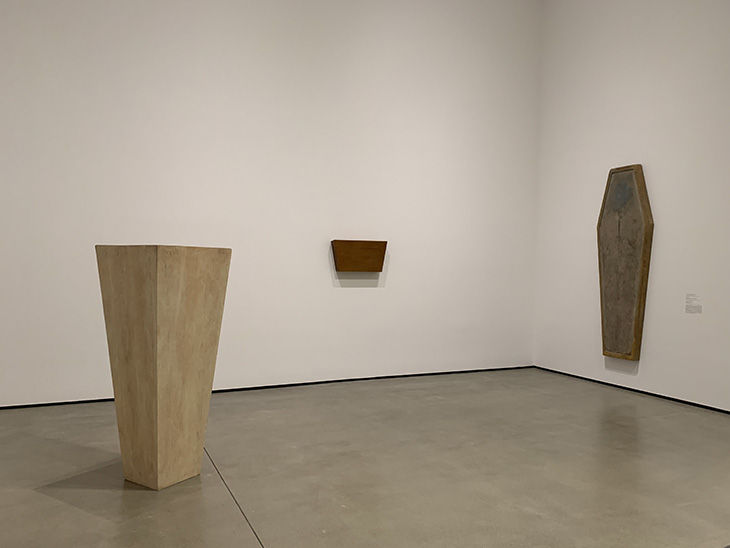
Although the early paintings and sculptures by Robert Therrien (1947-2019) are simple and elemental in form and have at times been associated with Minimalism, this forty-year retrospective reveals that reductive art was influential primarily on Therrien’s formal vocabulary but was not his primary source of inspiration at all. Rather, his ideas were generated mostly by personal memories, often from childhood.

While monochromatic sculptures like “No title (keystone)” and “No title (bent cone relief)” (both 1982) share a block-like structure that was common to Minimalist works by Donald Judd and others, Therrien’s surfaces are modulated with gestural markings and subtle color gradations comparable to similar treatment in paintings by Color Field artists such as Robert Ryman (1930-2019) and Brice Marden (1938-2023).
Additionally, Therrien’s works are referential — a taboo for Minimalists — with the keystone shape representing an element of architecture and the bent cone whimsically evocative of a wizard’s hat that is partially folded over. In this regard, his works of the 1970s and 80s are closer in spirit to Joel Shapiro’s (1941-2025) geometric sculptures based on human figures, or the semi-abstract figurative forms by 1970s “New Image” painters such as Susan Rothenberg (1945-2020) and Robert Moskowitz (1935-2024).
In terms of process, Therrien could be aligned with Sol LeWitt (1928-2007) in that both would investigate a particular shape and explore its many variations. Yet, whereas LeWitt worked according to rule-based systems that were conceptually restrictive and mathematically precise, Therrien approached the metamorphosis of his visual lexicon more intuitively, as if responding to a Rorschach personality test, welcoming ambiguity and multiple interpretive possibilities. His keystones, for example, evolved from slicing laterally through an image of a coffin, while the bent cone is closely connected to similarly shaped Therrien objects such as a tea kettle or a bird’s head. Broad curator Ed Schad deserves credit for directing attention to these relationships by installing many of the early sculptures and paintings in illuminating groupings.

While Therrien’s earlier works may be contextualized in terms of various art movements of the time, the artist found his unique voice in the 1990s, when working with a fabricator led him to considerations of scale. This shift resulted in works that address the space or architecture of a room and the viewer’s physical relationship to the object, factors that increase the potential for narrative and metaphoric content.
With larger-than-life-sized sculptures such as “No title (stacked plates white)” (1993) and “No title (room, pots and pans I)” (2008-15), Therrien sparks a sense of wild adventure down Alice’s rabbit hole while emphasizing the ubiquity of banal kitchen objects in our daily lives. The former sculpture, which stands almost 8 feet tall, has a somewhat dizzying effect as the stack of dishes seems to be spinning and about to topple. As for narrative implications, the unstable dish pile brings to mind scenarios from vintage cartoons wherein a waiter attempts to balance an overly tall stack of plates. The pots and pans in the latter work, by contrast, can only be peered at from outside a closet-sized room into which they are stuffed, with the incongruity of their oversized scale leaving us pleasantly befuddled: Do they belong to an alternate universe of giants?
Such scale distortions are especially effective in Therrien’s installations of mammoth-sized furniture, which dwarf us such that we seem to have become inhabitants of microscopic civilizations like those in a couple of episodes of “The Twilight Zone.” Examples of works that we can physically stand under include “No title (folding table and chairs, dark brown)” (2007) and “No title (table leg)” (2010), as well as “Under the Table” (1994).
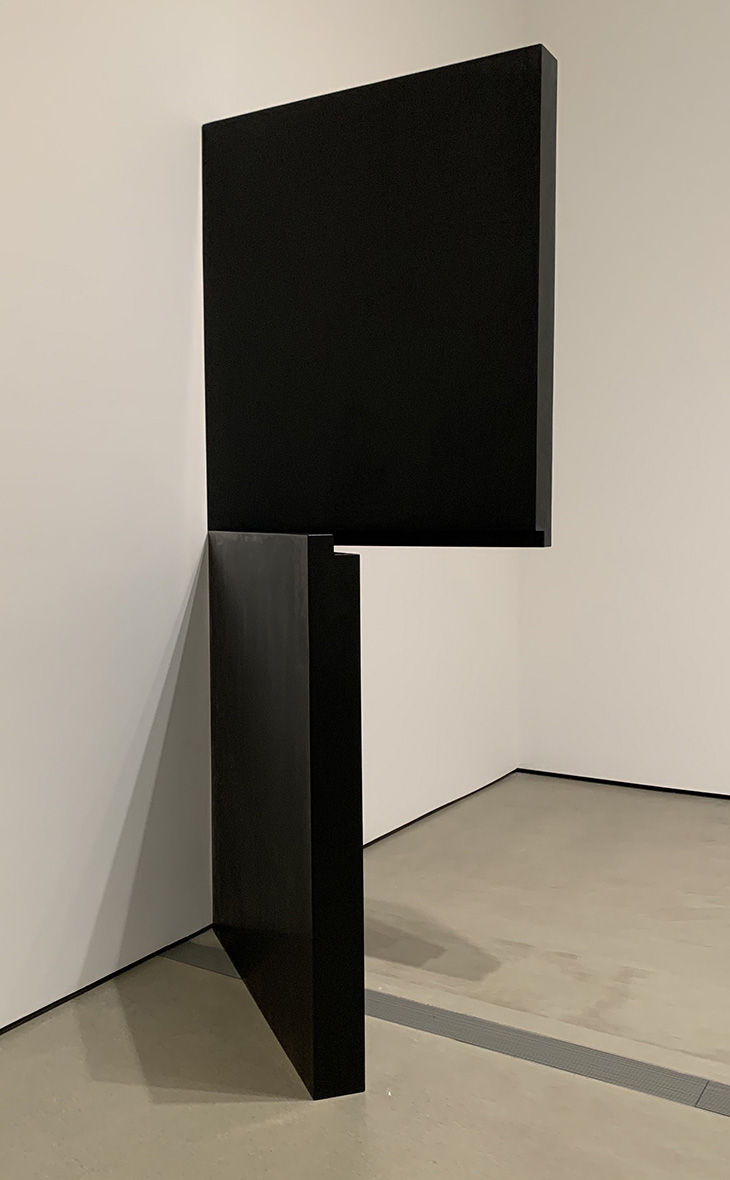
One of the points articulated in the exhibition’s helpful didactic panels is that Therrien’s studios were routinely evolving installations in their own right. His fascination with architecture is strongly apparent in two of the most elegant and provocative works. One is abstract, the other decidedly representational. Sleek and sumptuous in form, the all black wooden structure “No title (black Dutch door)” (1993-2013) is based on actual doors from the artist’s childhood home. But he has removed all details such as knobs, hinges, or keyholes, and affixed it directly to the wall, with the upper and lower sections positioned at different angles in a way that makes us want to view it from multiple vantage points. While superficially resembling a Richard Serra (1938-2024) steel work, it is much more approachable in the sense that it supplants Serra’s cold industrial aesthetic with one that feels soft and poetic. By comparison, “No title (room, panic doors)” (2013-14) elicits a more cerebral reaction. A large rectangular structure that resembles the freight compartment of a moving van and houses a replica of a brightly lit hallway and doors, the installation resembles a movie set that fills us with anticipation. We could easily imagine the doors busting open and an emergency care team racing towards us with a patient on a gurney.

Therrien’s versatility is also expressed in the subtle humor that shows through in a scattering of works, such as the charming collage “No title (devil wallpaper)” (1983), where he cleverly undermines the lyrical tone of patterned wallpaper by silk-screening the devil logo from Underwood deviled ham onto the preexisting floral motifs. Also noteworthy for its whimsy is “No title (large telephone cloud)” (1998), a monumental cartoon bubble/cloud formation constructed from old telephones and wires that evoke the millions of connections and talking voices that permeate the world’s telephone lines. Although serious in vision and intentions, Therrien was an avid fan of vintage comic books and was himself quite adept at making art that leaves us smiling.

David S. Rubin is a Los Angeles-based curator, writer, and artist. As a curator, he has held positions at MOCA Cleveland, Phoenix Art Museum, Contemporary Arts Center New Orleans, and San Antonio Museum of Art. As a writer he has contributed to Art and Cake, Art in America, Arts Magazine, Artweek, ArtScene, Fabrik, Glasstire, Hyperallergic, and Visual Art Source. He has published numerous exhibition catalogs, and his curatorial archives are housed in the Smithsonian Archives of American Art.
For more information: www.davidsrubin.com.


Comments