
Spencer Finch, “Balboa of House and Garden”

by Jody Zellen
Lisson Gallery, Los Angeles
Continuing through August 22, 2026

In 2013 “The Gorgeous Nothing,” a facsimile edition of fifty-two poems Emily Dickinson composed on scraps of paper and discarded envelopes was published, giving readers the opportunity to encounter these handwritten creations firsthand. Following Dickinson, Spencer Finch has created his own version, “Gorgeous Nothings,” a series of intimate, works on paper that are installed unframed as a frieze along the gallery walls.

Finch is best known for ethereal light installations in which he covers windows with colored gels to transform the aura of an interior space so as to parallel his experiences of natural phenomena. “Balboa of House and Garden” includes two of these pieces, but they are not the primary focus of the exhibition. One consists of three fluorescent fixtures wrapped with blue filters or gels. In the main gallery, Finch has covered the skylights with transparent strips in various shades of blue — informed by light measurements Finch made of a passing cloud in Dickinson's Amherst, Massachusetts garden. When the light is right, they cast an array of blue-hued shadows onto the walls and floor.
The second installation sits outside the gallery, “Wreck (Raft of the Medusa)” (2026) is situated in a found commercial dumpster filled with casually presented but carefully chosen detritus that resembles a dilapidated raft. It is, of course, a tongue-in-cheek interpretation of Théodore Géricault’s iconic “The Raft of the Medusa” (1818-19).
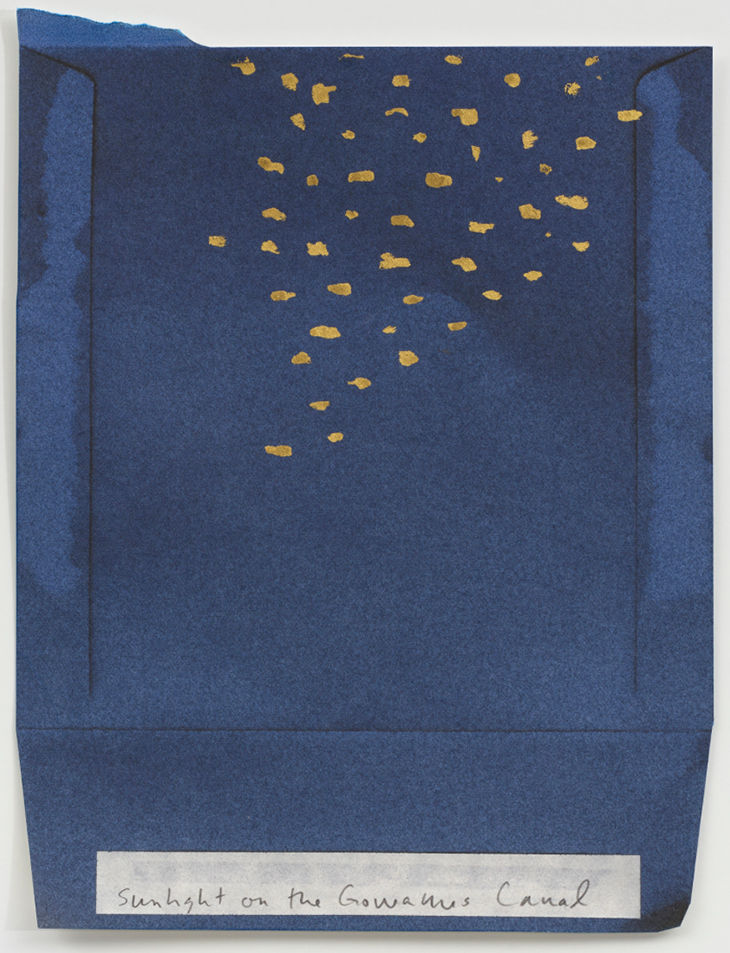
While these larger pieces align with Finch's body of work in general, it is the “Gorgeous Nothings” that are the centerpiece of the exhibition. To realize this rich, subtle, evocative body of work Finch collected scraps of paper — picking up envelopes from the street or saving junk mail he received, as well as gathering fragments from his personal correspondence. Rather than draw atop the found envelopes or use them for collages, he scans the originals, prints and then cuts the shape to scale from pieces of archival inkjet paper. He uses these "reproductions" as backgrounds on which he draws, paints or collages other materials, often creating a trompe l'oeil effect. H andwritten poetic captions are present toward the bottom of many of the images to identify the what and the where.
For “Gorgeous Nothing 10, After JJ” (all works 2026), Finch begins with a security envelope open so that the blue crosshatched pattern faces out. Over this he collages orange, green and purple shapes that quote Jasper Johns’ painting “Momoyama” (2025). In “Gorgeous Nothing 44, After Matisse,” Finch pays homage to the French master in his depiction of a small cluster of flowers — cyclamen — in the blocky style of Matisse's cut-outs. The ground is an off-white envelope that is open like a book and torn. Another homage, this one to Ed Ruscha, occurs in “Gorgeous Nothing 28, Sunset from Sunset Blvd. 3/3/26,” a watercolor of a lone palm tree set against a yellow-blue gradient — the referenced sunset — filling the top portion of the envelope.

Finch's envelopes are small, the size of the original correspondence, and because they are cutouts they are not uniform. This is what makes them intriguing. They are extremely personal, filled with observations that are more banal than extraordinary, but Finch elevates the everyday into something special and poetic. For “Gorgeous Nothing 16, Sunlight on the Gowanus Canal,” Finch adds gold leaf to a dark blue envelope referencing sunlight reflected on the famous canal in Brooklyn. The caption at the bottom of “Gorgeous Nothing 14, Following a bee,” simply states "following a bee." This image juxtaposes a printed piece of wallpaper from Emily Dickinson's bedroom that features a red flower. Finch has imposed a heavy pencil line emanating from the flower to the edges of the page that simulates the flight of a bee without depicting the bee itself.

Because envelopes are normally considered expendable, they are not something that most people pay a lot of attention to. But, given their variations in shape, size and color, as well as the patterns that fill many of the interiors, they exert their individuality. Finch's augmentation and interpretation further transforms them into something precious and valuable. In “Gorgeous Nothing 8, After Brecht (1939),” a beautifully rendered tree surrounds the address window of a direct mail campaign. The envelope from UNHCR addresses Spencer, stating, “an urgent request from the front lines of the war in Ukraine.” REMINDER is stamped in red. Finch has inscribed the envelope with a handwritten text inspired by Bertolt Brecht: “What times are these when a conversation about trees is almost a crime because it includes a silence of so many horrors.”
Each of the 50 plus artworks is different type of meditation — be it on time, nature, culture, or art — his own or that by others. Some are simple, others are quite complex. The series displays both formal and conceptual rigor and when viewed in relation to the subtle transformation of the light in the room it becomes evident that Finch's intentions are to use everyday materials and experiences to change the banality of what he has been given into something unexpected that frequently offers a burst of surprise. It’s better than an homage to Dickinson, it’s an aesthetic collaboration.

Jody Zellen is a LA based writer and artist who creates interactive installations, mobile apps, net art, animations, drawings, paintings, photographs, public art, and artist’s books. Zellen received a BA from Wesleyan University (1983), a MFA from CalArts (1989) and a MPS from NYU's Interactive Telecommunications Program (2009). She has exhibited nationally and internationally since 1989. For more information please visit www.jodyzellen.com


Comments