
Willie Birch, “Stories to Tell”

Updated: Jul 28
by Liz Goldner
California African American Museum, Los Angeles, California
Continuing through October 21, 2026

The works of Willie Birch are unusual and complex examples of narrative art. His first major retrospective portray him embracing life’s varied states of mind, including “pain and joy, vulnerability and pride, endurance and resistance,” according to the catalog, through a selection of 85 paintings, portraits, drawings, prints, sculptures and installations.
Born in New Orleans in 1942, Birch draws on his diverse family background for inspiration. Relatives are activists, community leaders, teachers, and preachers. Birch studied art in disparate parts of the country and world, living in New Orleans, New York, Baltimore and Amsterdam, to achieve an abundance of perspectives. In many pieces, the artist, who has also worked as a community organizer, is informed by his African ancestry, the civil rights movement, jazz, Egyptian numerology, and American folk art.
Birch’s oeuvre emphasizes accessibility, humanity and spirituality. Exhibition curator Russell Lord, chief of curatorial affairs at the Norman Rockwell Museum, sees a body of work rooted deeply in empathy and a holistic approach that is borne out by the exhibition.
“Uptown Memories (A Day in the Life of the Magnolia Project)” (1995), composed from painted papier-mâché and mixed media, depicts a young Black man contemplating what his life might be like as an artist. The deftly crafted sculpture presents the subject absorbed in reading a book while perched on a city stoop. The stoop displays images of the city around him, and a small portable radio is placed next to him.
While no other figures occupy this piece, there is a powerful sense of humanity gathered around the young man, as evidenced by other nearby sculptures. These include a family traveling, another family walking through town, a young man catching birds, and several of schoolchildren on whose backs are written phrases such as “Those who ignore the past will be forced to relive it,” “Why do we say Columbus discovered America?”

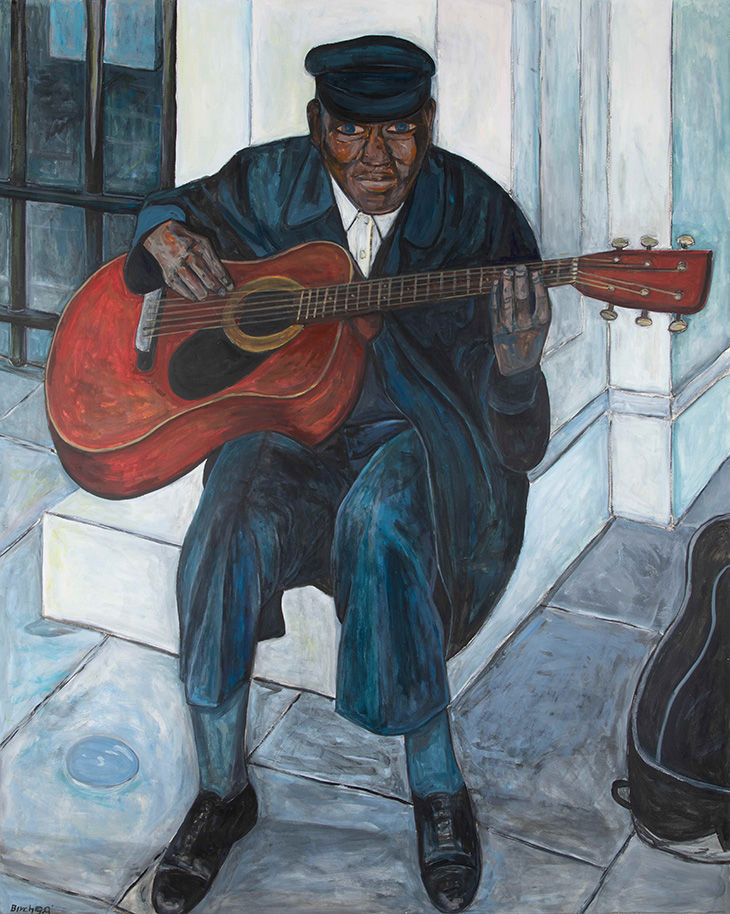
The implied sound of words and music is a key element that rises above the silence of Birch’s imagery. The acrylic and charcoal “Street Musician with Guitar” (1999) focuses on a man who Birch often sees in his neighborhood. The intense subject, depicted in a social realist style, stares out at us, establishing an immediate connection. I imagine him harboring stories about a life spent as a Black man in the south which he is bursting to share. The hieroglyphic writing of “New York City Jazz” (1978) is based on the synesthetic concept of sound becoming visible.
“Two Faces of a Nation” (1968) is an assemblage of found objects representing a besmirched American flag. The caveat of the piece is expressed through the presence of a dustpan, broom, hammer, gloves and heavily worn shoes. These objects indicate that our country is no picture-perfect land of patriotic song and storybook, but a muddied continent, built on the back-breaking labor of marginalized citizens. The flag appears to be made of cloth that has been pulled over the tools of labor, rendering the stars and stripes folded and torn by the objects beneath them. The work expresses the then-young artist’s dark perspective on life during the 1960s.

Reflections on that tumultuous decade continue in the years since. “Memories of the '60s” (1992), a deftly crafted papier-mâché, canvas and mixed media sculpture, depicts an African American woman working on a blood-red quilt. It illustrates through pictures and text episodes of racial violence that Birch witnessed. Sewn into the quilt are pictures of protestors linking arms, members of the Ku Klux Klan, Martin Luther King, a clenched fist, a flag and statements such as, “The price of freedom is death.” “Freedom is not free,” and, “I don’t see an American dream. I see an American nightmare.”
Beyond these highlighted works are spiritually-inspired installations portraying passages through life, deftly executed wood carvings, and semi-abstract paintings. Also featured are colorful works from the 1980s of people Birch encountered in New York City, including those in a barbershop, a multi-racial neighborhood dinner, and hanging out at home. The topical commentary is exemplified by “Keeping Up With the Iran-Contra Hearings” (1987), which centers on a Black woman, her head scarf signifying that she is a maid in a well-appointed home that is clearly not hers, becoming mesmerized by a news image on TV.
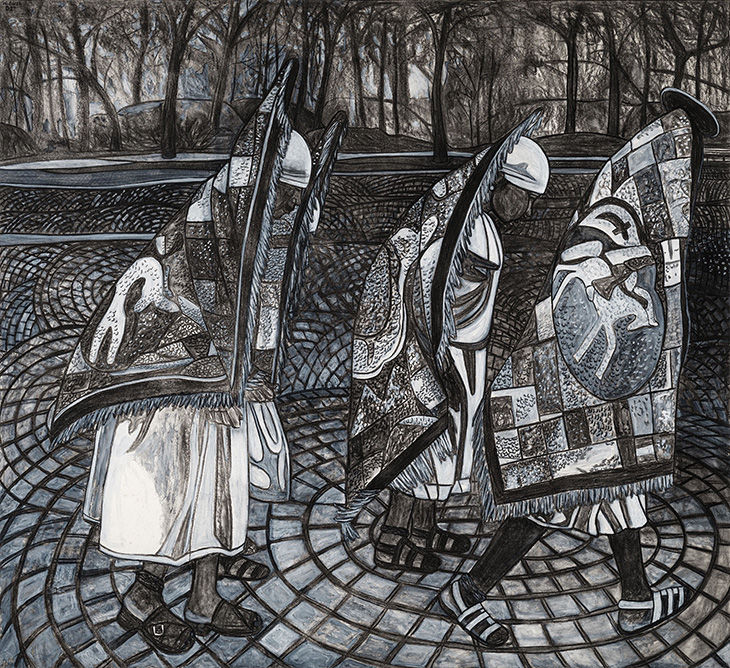
The final section of the exhibition is composed of several large-scale charcoal and acrylic works on paper from the artist’s “Seventh Ward” series. Birch began these pictures after 1994, upon returning to his hometown of New Orleans. He deftly captures street scenes, people and architecture from one of the city’s most historically vibrant neighborhoods. It was arguably the birthplace of jazz, home of the Mardi Gras Indians, and the marching ground of the annual Black Men of Labor Second Line Parade. While the scenes are local, the stories are universal. Images of horses, boys loaded into the back of a pickup truck, young men playing dominoes, people cleaning a street following a local shooting, and a 1977 Chevy all immerse us in the ward. Especially affecting is the spiritual drawing, “Evoking the Spirits of the Ancestors” (2002), of three hooded and robed men walking solemnly through town.
This expansive aesthetic of “Stories to Tell” befits an artist who has imbued his body, mind and spirit into the many vicissitudes of Black life in America. The stories are compelling and, as numerous as they are we come away understanding that, in the best way possible, there are still many stories yet untold.

Liz Goldner is an award-winning art writer based in Laguna Beach. She has contributed to the LA Times, LA Weekly, KCET Artbound, Artillery, AICA-USA Magazine, Orange County Register, Art Ltd. and several other print and online publications. She has written reviews for ArtScene and Visual Art Source since 2009.


Comments