
Norman Lundin, “Landscapes, Mostly, Other Things Too”

by Matthew Kangas
Greg Kucera Gallery, Seattle
Continues through May 16, 2026

Subjectivity of vision is one qualifier for legitimate realism, and Norman Lundin’s new paintings express that in spades. Seen in an exhibition titled “Landscapes, Mostly, Other Things Too,” Lundin’s breadth of vision and subject matter has never been more evident or elegantly expressed. To each traditional genre he explores — landscape, still lifes, figures — he brings a deeply personal, often brooding and ominous insight that obliquely reflects the darker elements of the time we inhabit, including environmental danger, strained personal relationships, and the tendency to escape into worlds just this side of fantasy.
Now approaching 90, Lundin has had a lifetime of international achievements both as a painter and as an admired teacher, with numerous visiting residencies piled on top of his 40 years at the University of Washington School of Art. His tenure there was somewhat at odds with the 1920s School of Paris ties of department co-founders Ambrose Patterson and Walter Isaacs and their students’ postgraduate studies with Fernand Léger in Paris. Lundin’s closest friend on the faculty, Francis Celentano, was a pioneering Optical Perceptualist. Could their influence have had an effect on the bracingly formal compositions of their younger colleague despite his hyper-traditional training in Norway and at the Art Institute of Chicago and the University of Cincinnati?
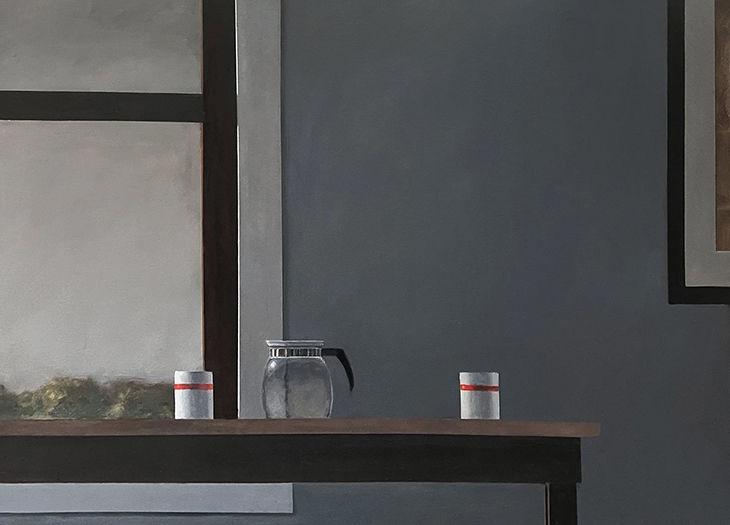
Examining the 19 paintings on display, all done just in the past two years, the formalists’ shadow is unmistakable. Gridding up the picture plane, as in “Studio Evening,” “Studio Floor and Wall” (both 2025) and “Coffee Pot and Two Cups” (2026), Lundin’s pictorial strategies seem haunted by his late colleagues in a way that only strengthens their staying power and adds to their mysterious content. Still life and landscape elements are so separated from one another that they tempt a symbolic reading.
Colors are restricted, too, as if in a Cubist palette, so that a bright red band on a paper cup sticks out and a thin white line of sunset above the ocean beach doubles as a pure horizontal line regardless of the landscape depicted. A captive of realism due to his training and teaching, Lundin has escaped tedious repetition of subject by varying each encounter with nature or the studio, averting strict identification in favor of delicately placed objects and closely observed outdoor scenes, increasingly darkened by weather, wildfire smoke, and the solitude of a studio.

The studio window is a constant in the new interiors, often seen late in the day, prodding us to gaze out at indeterminate skylines or adjacent buildings and construction sites. In turn, these take on the role of formal organizers, pulling each painting together in ways that go beyond the mundane subjects of the scene: tables, coffee cups, water carafes and cardboard boxes. For example, in “Across the Studio” (2026) a white plastic detergent bottle sits on a table between a cropped stepladder on the right and three paintings to the left stacked against the wall with their backs facing us. Seemingly random, the composition is a perfect balance among the elements. Two smaller cardboard boxes peek out from behind the ladder. Redefining a still life, Lundin inserts objects of autobiographical significance. They render the composition a quiet tour de force and a talisman of the artist’s activity within the privacy of the studio.
In “Box and Three Jars” (2025), the centered cardboard box atop a black table holds the jars above a white can against a gray background. To a modernist, the “Homages to a Square” series (1950-1976) of Bauhaus master Josef Albers are inescapable historical forerunners. With “Light Bulb and Drapery” (2025), the light bulb acts as a pun for effusive artificial light throughout, and the drapery is an oblique homage to Lundin’s old friend, stripe-painter Celentano.

The new landscapes are familiar but tinged with a gloom that is the formal result of smoky late-afternoon or evening skies and smoldering forests nearly set on fire. Together with the still lifes, they, too, offer potentially symbolic readings of nature in peril. In a crowd of younger eco-conscious landscape painters, these recent views lift Lundin beyond his realist and modernist legacies with great ease that makes for a late career triumph.

Matthew Kangas writes regularly for Visual Art Source eNewsletter; Ceramics: Art & Perception (Australia); and Preview (Canada). Besides reviewing for many years at Art in America, American Craft, Art Ltd., Vanguard and Seattle Times, he is the author of numerous catalogs and monographs, the latest being the award-winning Italo Scanga 1932-2001. Four anthologies of his critical essays, reviews and interviews were issued by Midmarch Arts Press (New York) and available on Amazon at Books by Matthew Kangas.


Comments