
Rachel Dorsey, “Careworn”

by T.s. Flock
ANTiPODE, Seattle, Washington
Contact gallery for closing date

Any artist who ventures to address the slippery subject of intimacy always risks succumbing to sentiment. The domestic, the everyday, the emotional: these are all subjects that naturally invite tenderness, and art history is littered with versions so saccharine that they no longer say anything about real life.
But the artist who refuses such complacency understands that the domestic realm and the bodies that inhabit it are places of friction and micro-catastrophe. Intimacy is not a montage of charming vignettes. It is the primal scene of our vulnerability, where life is inscribed in things through wear and care.

To subvert sentimentality, Rachel Dorsey introduces this rough dimension in “Careworn,” her aptly titled solo show. She paints and draws directly on unstretched fabrics and blankets subtly stained and patinated with natural dyes. The technique successfully evokes a bodily sense of age even while being a bit more sanitary and archival than actual human sweat and rot. There are charming elements, but “charm” is not what Dorsey explores in domesticity. She is after its more corporeal nature: the lingering smudge, the uneven light, the awkward compressions of our personal space.
No two surfaces are alike. Some are meant to hang loosely, while others are made to hang flat. Some are opaque, while others are murky scrims with permanent shadows when viewed from behind against the light. Some come attended by other objects, like a chair leaning impossibly beneath or what looks like a crank handle protruding from the thin bar suspending the painting.
The latter case is found in “Basin Baby I and II” (a single work). The quilted surface is especially scrappy, such that the lower half of the eponymous baby appears divided among variously patterned and colored scraps. The green rickrack trim does not rejoin itself in the lower left corner; it hangs down to the floor. The infant is twisting its upper body and reaching out toward the left edge of the fabric, where the suspensory bar of the artwork terminates in a wooden handle. To the right of the infant, an almost monstrously large adult hand scoops up the head. The overall effect is that the bottom half feels disturbed and divided, while the upper half has a smooth rhythm of hands and bodies curving over each other. And yet, even given this rhythm, one is reaching towards the other, and the other seems determined to get away.
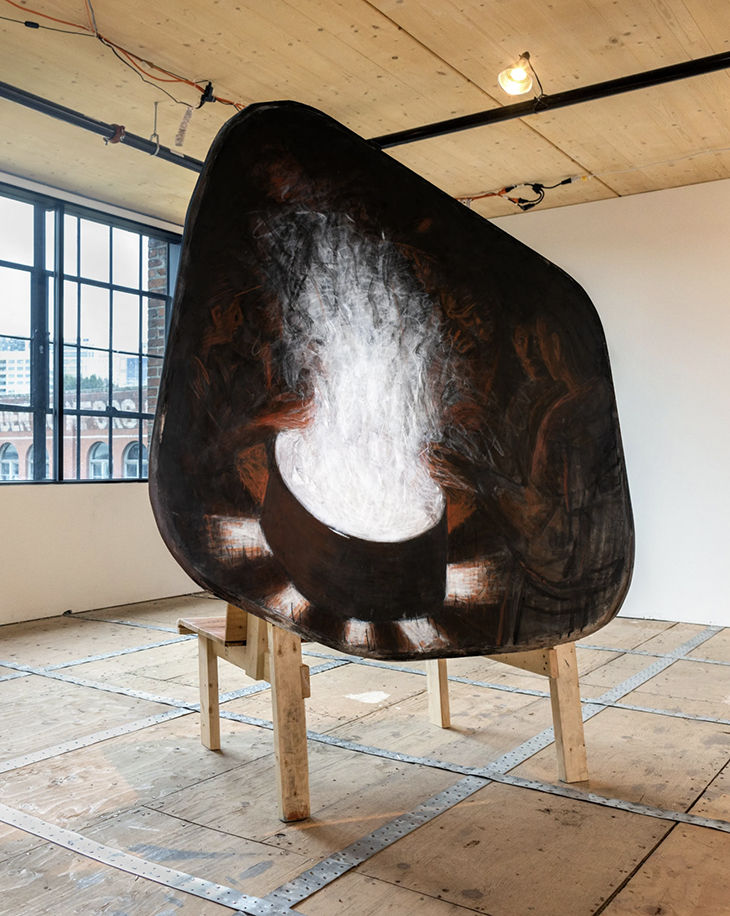
“Three’s Company, Two’s a Crowd (after Albertinelli)” does not explicitly reference Mariotto Albertinelli (1474-1515), but the adult figures in Dorsey’s larger works often feel evocative of classic portraiture through composition, posture, and the vagueness of their attire, which tends toward cloaks and shawls that give the bodies volume without a distinct edge. They provide a sense of timelessness rather than suggesting an historical period.
Thus, in “Careworn” both the material dimension of the works and the drawn and painted figures direct us toward a confrontation with the messiness of creating lives together rather than nostalgia. And like the formal quality of Dorsey’s surfaces, the figures are emotionally raw and evocative in a way that also asks to be inhabited. Despite their messiness, the works feel very harmonious in this regard.
Dorsey’s works seek multiple avenues to reintroduce the body beyond merely representing it. Not an idealized body, but the real body, the one that sweats, that fails, that falls, that repairs itself, that starts all over again. And with the body comes community, for this human condition is precisely what we share most intimately. Art that embraces fragility and wear and tear de-dramatizes what, in isolation, might seem shameful or repulsive, and places it back within the normal continuum of existence.
The piece most illustrative of this is “Attendant (for MVK and MJK).” At a distance, it appears to be a deathbed scene, with the recumbent figure obscured by so many bodies and faces surrounding it. Walking along its nearly nine-foot length, one must take one’s time discerning the various faces sketched sensitively to evoke peace, acceptance, pleading, or sorrow. This would be gratifying enough, but then one steps back slightly and looks down and discovers that “Attendant” renders not one moment in time, but several.

To the lower left, among the turned backs of the figures above, is an embedded scene from another time and place: a woman wearily gazing off to one side and a young girl resting her head on her crossed arms over the edge of some ambiguous barrier. The whole scene is rendered in vivid turmeric orange, as if they were illuminated by a single dim lamp.
Surrounding them, more indistinct and ghostly figures are bowing and leaning through the shadows. Following them to the right are two ghostly little dogs. One seems to be staring curiously at the face of a more completely sketched sleeping infant. Move your gaze back up, you are back at where one would expect to find the head of the unseen figure at the center of the composition. In its ambition and complexity “Attendant” is the apogee of the exhibition.
Not all of Dorsey’s works compress time and space so explicitly, but this refusal to reduce the subject to a decorative staging is thematic in “Careworn.” And this brings us to the space itself, for it, too, plays a part.
Dorsey’s work would have suffered in a pristine white cube. This gallery’s rough-hewn stone walls tell their own stories. In fact, as I was descending the stairs from the sidewalk to the gallery entrance, someone was conducting a walking tour of the Pioneer Square neighborhood and telling the attendees about the long history of the building, and how ANTiPODE’s space in particular sat fallow off-and-on in the nearly two decades since the landmark Elliott Bay Book Company departed the neighborhood.

The gallery shares an entrance with the Seattle Jazz Fellowship, so that you cross between the bar and performance area before reaching the exhibition space. In short, the gallery itself shows its layers and seams, so Dorsey’s work feels right at home in this environment.
This is not a condemnation of white cubes, but the closer our spaces and appearances come to being impeccable, the more inhospitable they become. Smooth, sterile, immutable: These are places designed as stages, where art and visitors all perform the most controlled version of themselves. Under such conditions, to truly inhabit a space would mean risking contaminating it, introducing disorder and the indelible mark of human presence.
As the most attentive observers of our modernity have noted, a quest for flawlessness fuels shame. It reveals the gap between who we are and who we are instructed to be. This gap is a powerful factor in isolation: We minimize social interaction so as not to expose our space or our bodies to scrutiny. We withdraw. We sterilize ourselves.
In this context, Dorsey’s art points to the true substance of intimacy and proposes a far different logic of acceptance. The familiar becomes solidarity. By showing these traces, the artist says: These traces are universal.
Accepting this is a way of drawing closer to one another, for we cease to fear that others will see what we hide. And if art can dispel this fear, then it does more than simply reflect reality. It participates in the possibility of a less constrained connection, of a community more compassionate toward itself.
These reflections perhaps seem more poignant and urgent to me at this time because, beyond the walking tours at ground level, the federal government has begun expanding ICE operations here in the Seattle area. Reports have come to me from my network that ICE had begun aggressive door-to-door operations in nearby Redmond. This week, multiple schools in Seattle have moved to shelter-in-place formats to avoid the pattern of kidnappings by ICE we have been viewing in Minneapolis.
That ANTIPODE is run by immigrants from Tehran, with their focus on immigrant perspectives, is thus of special relevance to Dorsey’s work. While “Careworn” is not explicitly political, it is timely. Many of us are assessing our lives and duties to each other as we seek solidarity in the face of violent cruelty and inhumanity. It’s all very messy, but to rephrase my opening remark: Care and wear are not the unintended consequences of life; they are its inscription.

T.s. Flock is a writer and arts critic based in Seattle and co-founder of Vanguard Seattle.


Comments